
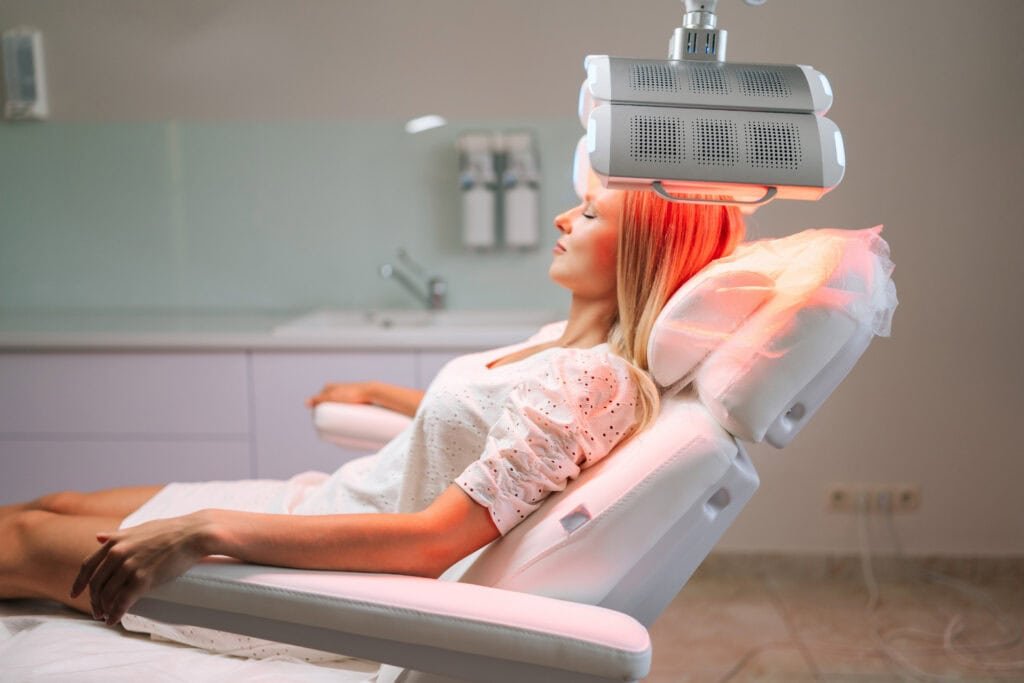
If you’re searching for “hair restoration near me in Houston, TX”, you’re not alone. Hair thinning and hair loss affect both men and women—and one of the most effective noninvasive options today is light therapy for hair growth.
At ROG Med Spa in Houston, patients often ask: What’s the difference between LLLT and LED light therapy—and which one actually works?
Let’s break it down so you can make an informed decision.
What Is Light Therapy for Hair Growth?
If you recall from physics, light is a form of electromagnetic radiation that behaves both as a wave and a photon particle, i.e. wave-particle duality.
Red light and near-infrared light have long wavelengths and travel deep into the scalp, allowing light energy to reach the hair follicles of the scalp, which are generally 4-6mm deep. Other colors of light (orange, yellow, green, blue) have shorter wavelengths and can only travel superficially into the skin; they simply cannot reach the hair follicle.
How Red Light Therapy Supports Hair Growth
Red light therapy helps improve hair growth by:
- Stimulating hair follicles at the cellular level
- Increasing blood flow to deliver oxygen and nutrients
- Reducing scalp inflammation linked to hair loss
- Potentially lowering DHT, a hormone associated with thinning hair
- Supporting thicker, healthier hair over time
Red light can be delivered as light-emitting diodes (LED), or as light amplified by stimulated emissions of radiation (Laser). Laser light for hair growth is delivered as low-level laser therapy (LLLT), also referred to as cold laser.
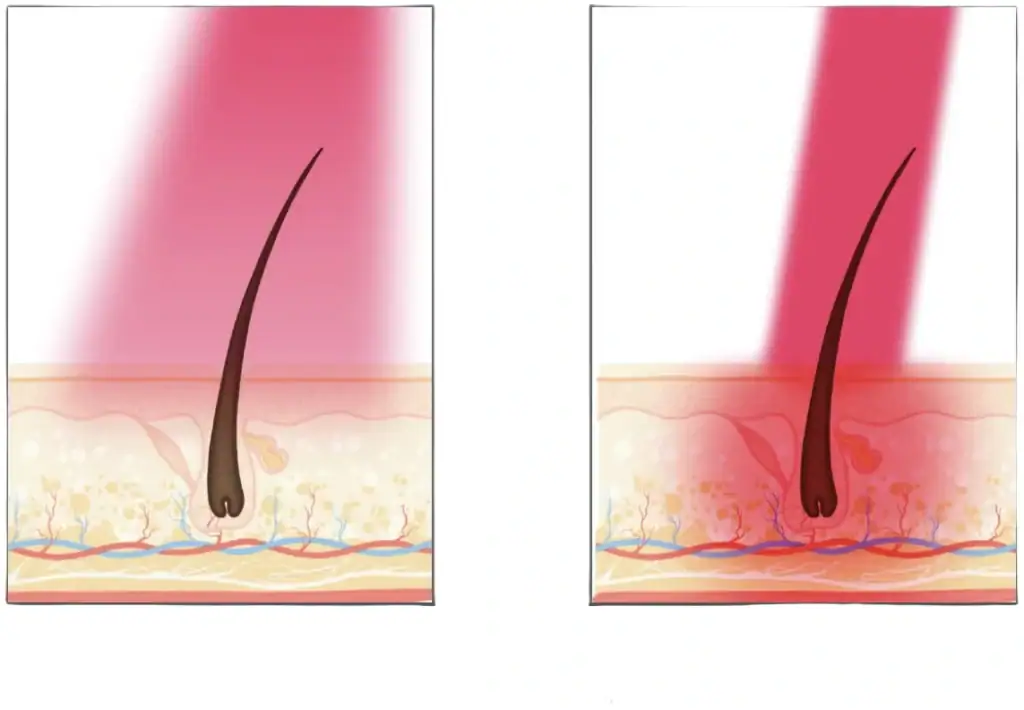
LED light (Left Picture) is non-coherent and broad. It penetrates deep into the skin but not deep enough to reach the base of the hair follicle. Low-level laser therapy (LLLT) (Right Picture) produces coherent and narrow light that is collimated and penetrates deep to stimulate the hair follicle. While both can benefit scalp health, their effectiveness and clinical strength differ significantly.
Low-Level Laser Therapy (LLLT): Medical-Grade Hair Restoration
LLLT uses specific wavelengths of red light to stimulate hair follicles, improve scalp circulation, and encourage hair regrowth through focused laser diodes that deliver coherent light energy directly into the scalp, precisely targeting hair follicles.
Benefits of LLLT for Hair Growth
- Stimulates dormant follicles and promotes the anagen (growth) phase
- Increases ATP production, energizing follicle stem cells
- Improves scalp blood flow and oxygenation
- Reduces inflammation that leads to follicular miniaturization
- Strong clinical evidence for androgenetic alopecia in men and women
- Deeper, more consistent penetration than LED therapy
Why LLLT Is Preferred in Medical Hair Restoration
Because of its precision and predictable dosing, LLLT is often used in:
- Physician-guided hair restoration programs
- Hair transplant recovery to improve graft survival and healing
- Patients with moderate to advanced hair loss
Clinical takeaway: LLLT delivers stronger biological effects and faster results, making it a top choice for patients seeking professional hair restoration near Houston.
LED Light Therapy for Hair Growth: A Supportive, Maintenance Option
LED light therapy uses diffused, non-coherent light, meaning the energy spreads in multiple directions instead of targeting follicles directly.
Benefits of LED Light Therapy
- Improves scalp circulation and overall scalp health
- Reduces inflammation and oxidative stress
- Supports hair thickness and quality over time
- More affordable and widely available (helmets, panels, handheld devices)
- Gentle option for early thinning or maintenance
Limitations of LED Therapy
- Shallower penetration compared to LLLT
- Slower and more subtle results
- Best used consistently over longer periods
Clinical takeaway: LED therapy can be helpful for maintenance or early hair thinning, but it’s not a replacement for medical-grade laser hair restoration.
LLLT vs LED Red Light Therapy: Quick Comparison
| Feature | LLLT (Diode Laser) | LED Light Therapy |
|---|---|---|
| Red Light type | Focused, coherent laser | Diffuse, non-coherent light |
| Penetration depth | Deeper and targeted | More superficial |
| Energy precision | High | Lower |
| Evidence strength | Strong clinical data | Moderate |
| Best for | Active hair loss, post-transplant recovery | Maintenance, scalp health |
| Typical setting | Medical clinics near you | At-home devices |
Who Is Light Therapy Best For?
Light therapy is ideal for patients looking for hair loss treatment who:
- Are experiencing early to moderate hair thinning
- Have genetic or hormonal hair loss
- Want a noninvasive, drug-free option
- Are recovering from a hair transplant
- Want to maintain results from PRP hair treatments or other therapies
For best results, light therapy is often combined with other treatments like PDGF for hair restoration.
A professional consultation helps determine which option will work best for your hair loss pattern and goals.
At-Home Devices vs Professional Hair Restoration
At-home LED helmets, caps, and combs can be helpful—but medical-grade LLLT provides stronger, faster, and more consistent results, especially when supervised by trained providers.
At ROG Med Spa in Houston, TX, we customize treatment plans that may include:
- LLLT laser therapy
- PDGF or Exosomes for hair growth
- Post-transplant laser support
- Long-term hair maintenance strategies
The Bottom Line: LLLT vs LED for Hair Growth
Both LED and LLLT red light therapy can support hair growth—but LLLT diode laser therapy is more powerful and clinically effective, especially for active hair loss and post–hair transplant recovery. LED therapy works best as a supporting or maintenance option.
Book a Hair Restoration Consultation in Houston, TX
If you’re searching for hair restoration near you and want real results—not guesswork—we’re here to help.
Book a hair restoration consultation at ROG Med Spa
Our Houston-based experts will evaluate your hair loss and create a personalized treatment plan designed for long-term success.
Healthy hair starts at the follicle—and the right light makes all the difference.